The Unspoken Accord – Part 2
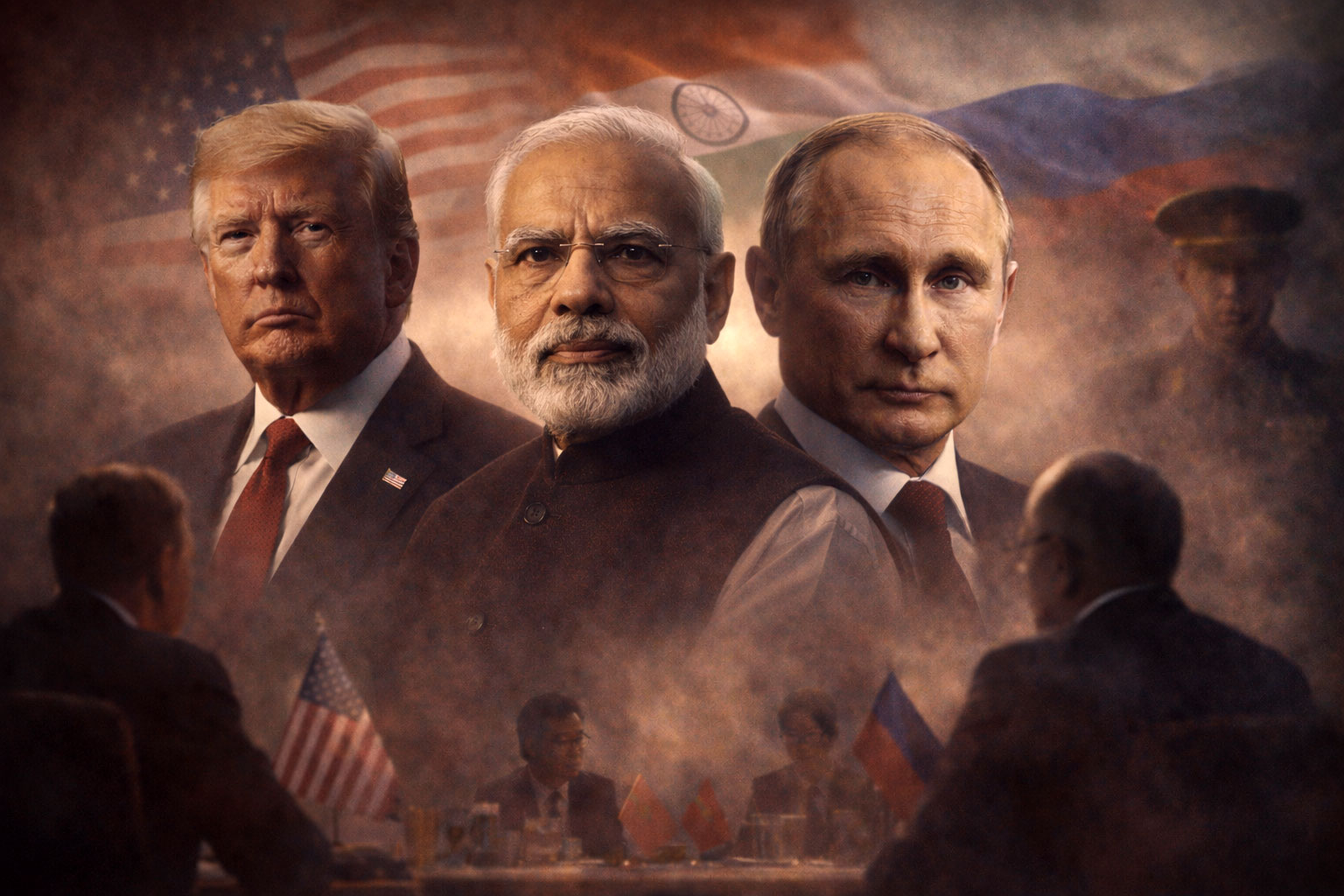
Russian President Vladimir Putin’s December 2025 visit to India for the 23rd Annual Bilateral Summit came at a time when the international system felt stretched, fragile, and strangely off-balance.
By the time Putin’s aircraft touched down in New Delhi in December 2025, the geopolitical message was already clear to those paying attention. The visit may have been framed as another ceremonial summit, another display of camaraderie between old friends, but the reality was far more consequential.
Wars simmered across continents, energy markets pulsed with volatility, and global alliances looked less like structures and more like shifting shadows. And in the middle of this uncertainty, three powers moved quietly beneath the surface… India, the United States, and Russia… each guided by its own calculations, yet converging toward a single consequence: China’s steadily tightening choke.
For years, Washington and New Delhi had strengthened an invisible axis… one built not through treaties or public declarations, but through synchronized moves, shared intelligence, shifting supply chains, and strategic pressure points. What appeared as independent national actions had begun forming a lattice around China. And while the world debated treaties, sanctions, and elections, a third actor watched with a smirk from the sidelines.
Russia.
Putin had never been comfortable with China’s expanding shadow across Central Asia, its creeping influence over the Arctic, or its demographic hunger for Siberia. The official Russian narrative painted Beijing as a partner and counterweight to Western pressure, but behind closed doors Moscow viewed China less as an ally and more as a long-term strategic threat. Yet Russia, weakened by sanctions and conflicts, lacked the leverage to confront Beijing directly. It needed a subtler approach… a way to reposition itself without triggering open confrontation.
When Moscow began detecting the faint but unmistakable pattern of U.S.–India strategic coordination, it did not expose the alignment. It joined it.
Quietly…
Naturally…
Almost elegantly…
Russian analysts had pieced the signals together long before Beijing did. Tariff wars that made little economic sense on paper. Indian naval maneuvers aligning perfectly with U.S. Pacific strategy.
Semiconductor restrictions that pinched China but left room for Indian advancement. Backchannel connections that linked Washington and New Delhi more frequently than either admitted publicly. Russia recognized a design the moment it saw one… and Putin, a veteran of geopolitical chess, understood the opportunity instantly.
Moscow offered New Delhi something deeper than weapons or investment. It offered options… alternatives to Chinese minerals, Chinese logistics, Chinese technological dependence. Russia possessed vast reserves of titanium, rare isotopes, strategic metals, gas corridors, and Arctic access routes that China desperately needed.
But more than that, Russia possessed “data”… a euphemism for the treasure trove of intelligence its cyber units had gathered from years of monitoring Chinese networks, ministries, military nodes, and strategic communications.
For India, still quietly navigating its role in the U.S.–China rivalry, Russian intelligence offered a mirror into Beijing’s internal anxieties, vulnerabilities, and political fractures. For Russia, sharing this information was not an act of charity… it was strategic leverage, a way to ensure India remained balanced between East and West, never fully absorbed by either.
Meanwhile, Moscow signaled its shifting stance through subtle geopolitical gestures that Beijing could neither confront nor ignore. Russian arms deliveries to China slowed noticeably. Joint military exercises were postponed without explanation. And in the United Nations, Russia quietly stalled or diluted Chinese-backed resolutions, raising eyebrows in diplomatic backrooms. None of these actions were overt enough to rupture Sino–Russian ties, yet all were sharp enough to unsettle Beijing’s confidence.
Beijing: The Panic Rooms
Beneath the Great Hall of the People in Beijing lies a series of underground chambers known only to senior Communist Party members. During crises… pandemics, purges, or foreign encirclement… these rooms host emergency Politburo sessions.
By mid-2020, those rooms were busy.
A thick map stretched across the oval table. Red pins marked India. Blue pins the US. Green pins Russia. The pattern looked abstract… until one placed a hand on each cluster.
Slowly, the map revealed an encirclement.
A young analyst from the Ministry of State Security whispered the phrase many feared:
“Sir, it appears India and the United States are coordinating semiconductor restrictions.”
Silence.
Then the Premier asked, “Which agencies?”
“Multiple,” she said, voice trembling. “CIA… State… Pentagon… and RAW.”
Another official added bitterly, “And Russia is not behaving like a partner.”
The General Secretary stared at the pins… US, India, Russia… forming a triangle around China’s ambitions.
“What exactly,” he asked, voice low and dangerous, “are Trump and Modi planning?”
No one answered.
They didn’t know.
And that was worse.
Beijing wasn’t facing a single enemy.
It was facing a silent axis.
The Battle of Supply Chains
China expected America to attack.
It did not expect India to become the second front.
Using private backchannels created during that Osaka meeting, India and the US shifted global supply chains:
- Pharma precursors moved to Hyderabad
- Medical devices moved to Pune
- Electronics moved to Vietnam & India
- Chip design hubs shifted from Shenzhen to Bengaluru
- AI datasets routed through US–India corridors
China’s export dominance began cracking like old paint.
Factories in Shenzhen saw foreign orders vanish overnight.
Local party officials reported “economic stress signals.”
Workers protested in Guangdong.
But it was the semiconductor collapse that truly broke Beijing’s confidence.
Without advanced chips, China’s military modernization stalled.
Hypersonics slowed.
Quantum research hiccuped.
Drones degraded.
The People’s Liberation Army was furious.
The Politburo was panicking.
Internal factions sharpened their knives.
China was not merely cornered by its enemies.
It was being suffocated by invisible supply-chain wires pulled by Washington and New Delhi.
Russia’s Gambit
Moscow watched the chaos with cold amusement.
Putin knew China’s economic stress would grow into political instability. And for him, an unstable China meant a weaker competitor in Asia and Central Eurasia.
So Russia made its boldest move.
It signed a 10-year strategic minerals pact with India, bypassing China entirely.
- Uranium to India
- Titanium to US aerospace via India
- Palladium to American semiconductor fabs
- Siberian gas at discounted, pre-negotiated rates
China protested.
Putin shrugged.
“Just business,” he said.
But Beijing understood the message.
Russia was shifting its weight.
Their worst nightmare was unfolding:
A US–India–Russia realignment, even informal, could suffocate China for a generation.
Inside Zhongnanhai, fear began turning into paranoia.
The Midnight Call
Late one night in Washington, Trump picked up a secure line. Modi’s voice came through, calm as ever.
“They’re panicking,” Modi said.
“I know,” Trump replied. “My people say Beijing is calling emergency meetings daily.”
Modi paused, then asked quietly, “Are you ready for the next step?”
Trump smiled, even though Modi couldn’t see it.
“Always.”
The world slept.
Markets opened and closed.
Ordinary citizens scrolled through social media.
Unaware that their future was being diced open in a midnight conversation between two men whose interests aligned just long enough to alter global architecture.
The Storm Begins
In Beijing, the General Secretary slammed a hand on the table.
“Enough,” he shouted. “We will respond.”
His advisors waited for instructions.
“Launch Operation Zhongtian,” he ordered.
A plan years in the making.
A plan to break the US–India axis.
A plan to sabotage semiconductor routes, influence elections, fracture alliances, and pressure Russia back into the fold.
But he didn’t know something critical:
US intelligence had already intercepted half the plan.
Indian intelligence had intercepted the rest.
And Russia… smiling in the shadows… was playing both sides for advantage.
China’s move had come too late.
The Axis was already in motion.
The world didn’t yet know it was hurtling toward a geopolitical storm.
The Faultline Agreement had set tectonic plates in motion.
And when great powers shift, continents tremble.
Putin’s India visit marked the moment when the geopolitical triangle sharpened. Not a U.S.–India–Russia alliance, but something subtler – three powers with intersecting interests converging on a single strategic reality… a rising China that had to be slowed before it reshaped the century.
And in Beijing, beneath the calm of public statements and the precision of rehearsed diplomacy, the quiet question grew louder:
If Russia is drifting, how long before the drift becomes a swing?
And what will China face… when all three shadows finally align?
Disclaimer
Where applicable, the content is disclosed as AI-generated / synthetically generated in accordance with Indian law. All content published under the Upspoken Accord is fictional and created with the assistance of artificial intelligence (AI). The stories, characters, events, and dialogues are imaginary. Any resemblance to real persons, events, or entities is purely coincidental. This content is intended solely for creative and literary purposes and does not claim factual accuracy or authenticity.





Post Comment