The Jerusalem Accord
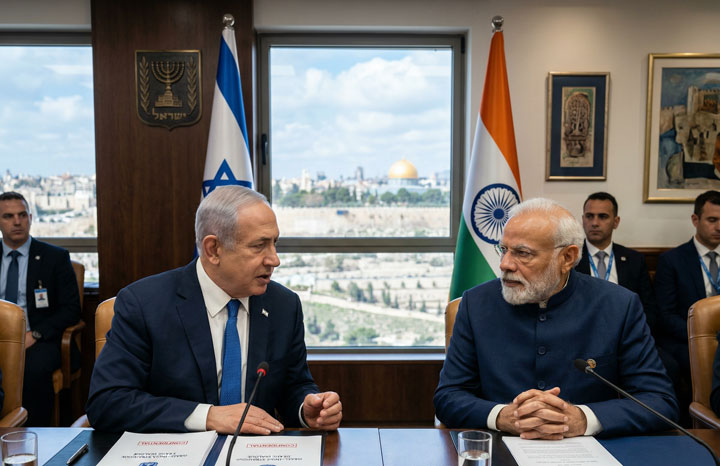
Prime Minister Narendra Modi had stepped off the aircraft onto the warm Jerusalem tarmac with a guarded optimism. The official state visit had been planned months ago… a two-day diplomatic mission aimed at deepening ties between India and Israel. There were speeches, commemorative honors, and promises of enhanced cooperation in technology, defense, and energy. Leaders spoke of peace and prosperity, but behind closed doors, tensions simmered.
Prime Minister Benjamin Netanyahu greeted Modi with warm hospitality, masking the pressures of regional tensions that rattled Tel Aviv. Iran’s influence across West Asia, and its expanding missile programs, had clouded every discussion.
The Secret Discussion
On the second evening, after a state banquet, the two leaders retreated to a private sitting in the Prime Minister’s residence… far from cameras and official statements. The table was strewn with tea, notes on defence cooperation, and the unspoken tension of what might come next.
Netanyahu leaned forward.
“Narendra,” he began quietly, “you know the situation with Iran. Their long-range missiles, their proxies, their nuclear ambitions… we cannot allow a future where they threaten Israel or any of our partners. Iran’s clock ticks louder. Missiles, nukes… they aim at Haifa, Mumbai, Delhi. We strike first. You stand with us?”
Modi nodded, remaining composed.
“I understand your concerns. India values its strategic autonomy and its friendships. We want stability for all. Modi leaned forward. “India balances. Iran gives oil, Chabahar port. But threats to my people? No. What do you offer?”
There was a pause.
Netanyahu slid a dossier across: Iron Dome co-production in Hyderabad… full tech transfer, $5 billion over five years. Arrow-3 interceptors for Andamans, guarding sea lanes. Heron TP drones with Israeli AI, assembled in Bengaluru. And the capstone: joint cyber ops against Tehran-backed hackers hitting Indian grids.
“Plus,” Netanyahu whispered, “real-time intel sharing. Our satellites spot their moves… you get feeds before Washington.”
Modi nodded slowly. “And in return? India greenlights your Iran window. No UN vetoes. Quiet logistics if needed. But we stay neutral publicly… Bharat’s way.”
Netanyahu set aside defence files and caught Modi’s gaze.
“We have planned a coordinated operation… with the United States… intended to neutralise Iran’s strategic military capabilities. The code-name is Operation Lion’s Roar.”
Modi’s eyes widened slightly… not in surprise, but in measured calculation.
“An operation of that scale,” he said, “will have consequences far beyond borders. Civilian lives, displaced people, escalating retaliation…”
Netanyahu nodded gravely.
“We know. But it is, in our view, necessary.”
Modi didn’t reject the seriousness of the threat, yet he reminded Netanyahu of India’s principles: peace, dialogue, and protection of civilians and regional stability… themes he would later reaffirm publicly.
Handshakes sealed it. The Jerusalem Accord: mutual defence elevation, tech flood, anti-Iran axis veiled as “strategic autonomy.” Netanyahu grinned. “Tomorrow, world sees handshakes. They never see this.”
The Roar Begins
48 hours later, as Modi’s visit officially concluded. By dawn February 28, Tel Aviv and Washington launched a coordinated air and missile offensive against strategic sites in Tehran. The military campaign was swift and decisive… high-speed jets, drones, and precision strikes targeted Iran’s military infrastructure. Precision hits: nukes crippled, missile silos vaporized, HQ in Tehran gutted. Khamenei’s bunker shook.
The operation was widely reported; it became known that U.S. and Israeli forces struck locations across Iran, including parts of the capital.
Television screens worldwide showed explosions blotting out Tehran’s skyline, airspace choked with fleeing aircraft, and anxious crowds seeking shelter.
Suddenly, the world watched in stunned silence.
Tehran screamed “Zionist aggression”… but Delhi stayed silent, citing “regional stability.”
Fallout Across the World
In New Delhi, government officials assembled urgently. Modi chaired a Cabinet Committee on Security meeting late into the night, focused on the volatile Middle East situation, the safety of Indian citizens abroad, and global economic fallout.
“India deepens ties with all friends. Peace through strength.”
Whispers spread: Why the timing? Leaks hinted Modi knew… perhaps nodded. Iran retaliated with drones on Gulf oil rigs; prices spiked. But India’s reserves held, drones from Israel already en route.
Opposition leaders across India criticized the timing of the attack so soon after the state visit, questioning whether India had prior knowledge or was kept in the dark. Calls for diplomatic clarity and balanced foreign policy echoed through parliament.
Over in the Gulf, missile alerts and evacuations sent waves of fear through millions of Indians living and working there. Humanitarian concerns rose alongside geopolitical calculations.
Iran did not sit silent. Its response came in the form of retaliation… missile launches into the Gulf region, strikes near shipping lanes, and warnings of further escalation.
A Phone Call Across Continents
With tensions spiraling, Modi reached out to Netanyahu over a secure phone line:
“I urge… in the strongest terms… a cessation of hostilities and respect for civilian safety. This region is too interconnected to be torn apart by warfare,” he said.
Netanyahu, somber, acknowledged the concern… but reiterated that Iran’s capacity to threaten peace necessitated action. Their conversation became a rare moment of international diplomacy in a rapidly burning theatre.
In a Tel Aviv war room days later, Netanyahu toasted: “The Accord holds. Iran blinks.” Modi, on a secure line: “Unpredictability wins. Bharat endures.”
Disclaimer
Where applicable, the content is disclosed as AI-generated / synthetically generated in accordance with Indian law. All content published under the Upspoken Accord is fictional and created with the assistance of artificial intelligence (AI). The stories, characters, events, and dialogues are imaginary or inspired by events. Any resemblance to real persons, events, or entities is purely coincidental. This content is intended solely for creative and literary purposes and does not claim factual accuracy or authenticity.





Post Comment