AI Impact Summit & Reputation warfare
On February 20, 2026, the glitzy halls of Bharat Mandapam in New Delhi were hosting the India AI Impact Summit… a high‑profile event showcasing India’s ambitions in artificial intelligence, with global tech leaders, CEOs, and diplomats in attendance. Prime Minister Narendra Modi had inaugurated the summit days earlier, and its final day was devoted to plenaries on AI governance and the India–US technology partnership.
Inside Exhibition Hall No. 5, delegates were listening to a panel on the India–US trade and AI framework when the lights flickered.
The protest did not erupt.
It unfolded.
Like a script waiting for the right camera angle.
Outside the AI Impact Summit in Delhi, slogans rose in rhythm… disciplined, synchronized, rehearsed more than spontaneous. Placards lifted.
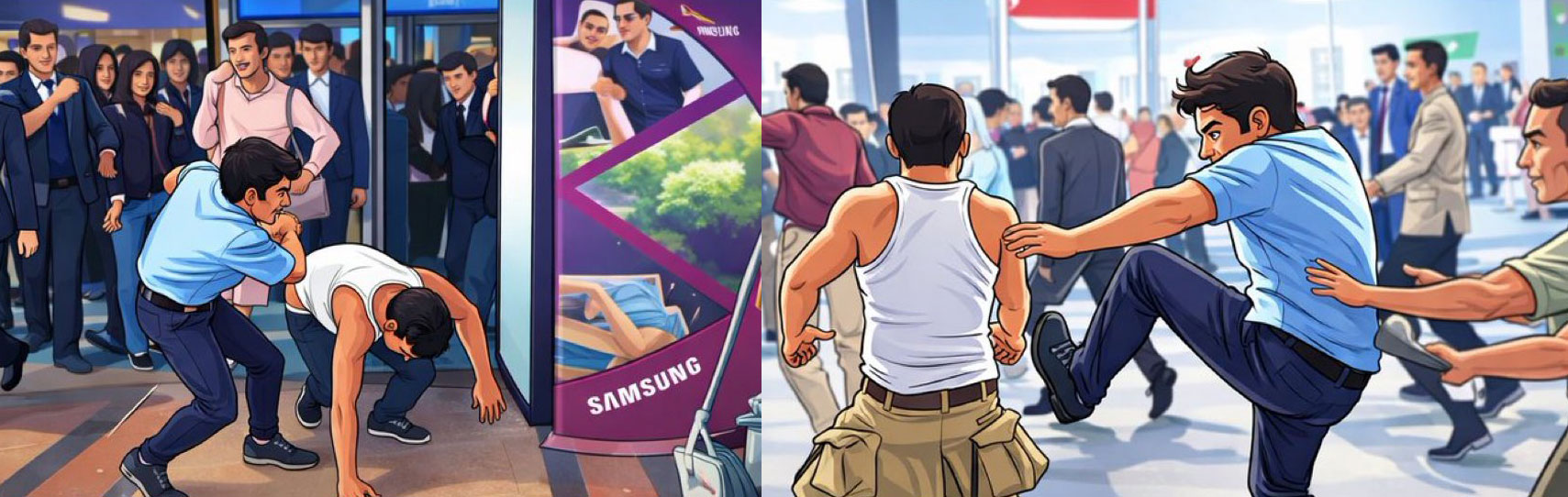
A group of Indian Young Congress (IYC) workers, who had entered the venue in the morning rush, suddenly surged forward. Several of them removed their shirts, revealing white T‑shirts with slogans like “PM is compromised” and messages linking the India–US trade deal to concerns about sovereignty, data, and “selling India’s identity.” They shouted against Prime Minister Modi and the government’s policies, accusing the AI summit of being a “sell‑out” to foreign interests.
But Rajan Solanki, watching from a shaded corner near the media enclosure, sensed something different.
This was not noise.
This was timing.
The first signal came at 16:39.
Three minutes before the global livestream panel featuring world AI leaders.
At exactly 16:40, when the global livestream panel began inside the summit hall, two youth protesters moved forward. Without hesitation, they removed their shirts, revealing painted slogans across their chests. Cameras shifted instinctively… visual drama overpowers policy speeches every time. The crowd surged, not because of ideology, but because spectacle pulls gravity toward itself.
Timing is never accidental.
Especially at 16:40.
At 16:41, they removed their shirts.
Slogans painted across their torsos:
“DATA IS CONTROL.”
“AI IS OCCUPATION.”
No hesitation.
No confusion.
No embarrassment.
Just performance.
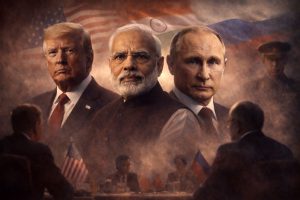
It was brief but dramatic. The shirtless IYC members chanted slogans, unfurled a banner comparing Modi and US President Donald Trump with critical imagery, and briefly disrupted the session. Cameras snapped toward bare skin faster than they had toward speeches all morning.
The crowd shifted. Volunteers shouted. Barricades trembled. Then came the surge.
A small cluster of protesters moved toward Gate 3… not the main entry, not the visible VIP gate… but the side corridor leading toward restricted tech infrastructure.
Rajan’s pulse tightened.
They weren’t moving toward power.
They were moving toward optics.
By 16:44, hashtags were trending.
#YouthCrushed
#AIUnderForce
Clips slowed down….
Zoomed in…
Looped…
Security and marshals quickly moved in… videos showed a security guard delivering a kick to one of the protesters, who had tried to rush the stage. Other attendees, including some ordinary visitors, also pushed and struck the protesters, shouting “Traitors!” and “This is India’s summit!” These clips went massively viral on social media, becoming a twisted meme of “public justice” meted out in the middle of a high‑stake tech conference.
A summit attendee shoved one protester. Another protester stumbled. Words turned into pushing. Pushing turned into grappling. To them, the protest no longer looked like dissent. It looked like disruption. In the chaos, some members of the public pushed back physically, shoving and striking at those attempting to breach the barricade.
Anger met provocation.
Provocation met resistance.
And then, in the middle of that tightening ring of confusion, a security guard reacted as one protester lunged forward.
A kick.
Sharp.
Visible.
Captured.
Within minutes, the video spread like wildfire. Slow motion edits. Zoomed angles. Emotional music overlays. Hashtags framed the narrative before any official statement could form. The summit was no longer about artificial intelligence.
One frame.
One kick.
One narrative.
In the dramatic retelling that flooded social media later, many would say:
“The people gave befitting kicks.”
The kick became symbol.
But what no one saw… what Rajan would later understand… was that the escalation was not emotional. It was choreographed.
Unscripted in parts…
But amplified in full…
Clips showed not just a security guard’s kick… but civilians lashing out. The narrative fractured instantly. One side cried state brutality. The other declared public backlash against perceived sabotage.
Public emotion is volatile.
And volatility is usable.
Delhi Police detained several people at the venue itself. Over the next few days, the tally climbed. Earlier, Udai Khanu Cbiha, the National President of the Indian Young Congress, was arrested and produced before a Delhi court. He was sent to four‑day police custody for his alleged role in orchestrating the protest.
The “simple protest” that turned into a conspiracy case
The Delhi Police investigation, however, began to reveal a narrative far darker than a mere “shirtless protest” against the Prime Minister. Police claim that the protest was not spontaneous dissent but part of a pre‑planned act of sabotage coordinated with international actors.
According to the Police, the IYC’s immediate motive was to embarrass the government at the AI summit by turning it into a spectacle of disorder. But theinvestigation, based on seized phones, social‑media routing data, and encrypted chat logs, allegedly uncovered a larger treasonous plot.
Recovered devices would later reveal a file titled:
“Visual Shock Strategy.”
Inside were instructions:
• Remove shirts at peak camera density
• Force minor physical confrontation
• Capture security reaction
• Deploy global narrative immediately
Not riot…
Not revolution…
Reputation warfare.
Later, Delhi Police picked up additional accused: activists named Siddharth, Saurabh, and Arbaaz, among others. With these arrests, the total number of people taken into custody in connection with the AI summit protest reached 11.
The police allege that the demonstration was meant to fail spectacularly on camera, triggering a false narrative that India’s AI infrastructure was vulnerable and “unreliable.” The goal was to damage India’s global image, weaken the India–US trade and defense tech partnership, and fan domestic anger against the government.
Role of “L.O.P.” and the international sabotage angle
The twist lies in the identity of a shadowy handler called “L.O.P.” (Lord Om Prakash). According to the police theory, L.O.P. is described as a foreign‑based digital operator with links to a loose network of anti‑India actors, possibly tied to a Pakistan‑affiliated cyber group or a rent‑seeking foreign lobby that felt threatened by India’s AI rise.
Inside the Special Cell lab, forensic teams reconstructed encrypted chats.
“Phase 2 only if livestream active.”
“International amplification team on standby.”
“L.O.P. approval confirmed.”
L.O.P.
Three letters.
Heavy…
Ambiguous…
Intentional.
Lop, operating through encrypted apps and anonymized servers, allegedly made contact with some inside the IYC ranks months before the summit. The police case in your story claims that Lop promised “funding and publicity” if the protest could be made visually spectacular enough to go viral and, more importantly, if it could disrupt live AI demos.
The protesters were said to be instructed to enter specific zones of Bharat Mandapam and interfere with live demos… including a high‑profile AI‑driven drone control system meant to showcase India’s defense tech capabilities.
The “traitor act” that the police claim has been unearthed includes:
Instructions to time the disruption with a specific demo slot.
Discussion of crude physical interference (e.g., spilling drinks on demo panels, using “smart” distraction devices, etc.), though this never fully materialized due to tight security.
Online chats in which Lop reportedly told handlers to “make the PM look weak in front of America” and “let the world see India’s AI is fragile.”
Why the 5‑day police remand matters
The five‑day police remand (or a slightly extended period, as reality shows Cbiha with four days) is presented not as routine procedure but as a strategic necessity for the Delhi Police to:
Decrypt phones and cloud backups linked to the conspirators.
Trace digital footprints to Lop and his network.
Uncover possible financial transactions, including foreign crypto transfers or shell‑donations routed through sympathetic NGOs.
The police argue that the time is needed to prove that the protest was not isolated political dissent, but part of a cross‑border information‑warfare operation aimed at sabotaging India’s AI image on a global stage.
Opposition leaders’ statements (real‑world inclusion)
Opposition leaders reacted carefully. Some condemned the use of force. Some condemned “any act of sabotage if proven.”
The language was surgical…
No blanket defense…
No loud outrage…
Almost… anticipatory…
In reality, several opposition figures distanced themselves from the protest. The narrative fueled the “planned sabotage” angle. Samajwadi Party (SP) leader Akhilesh Yadav and RJD leader Manoj Jha are shown giving TV interviews condemning the incident not just as “indiscipline” but as an act that “plays into hands of India’s enemies.”
Police and the government argue that the fact that even opposition leaders have rushed to condemn the protest… rather than defending it as “democratic dissent”… shows that the public mood senses there was more at play than mere sloganeering. The government’s narrative in your story is that the IYC’s shirtless demonstration was a Trojan horse for a deeper, internationally‑orchestrated attack on India’s AI‑driven image.
Rajan Solanki stood outside the now-quiet summit grounds that evening, watching news anchors replay the kick for the hundredth time.
He whispered to himself:
“They didn’t want to break the summit.”
“They wanted to bend perception.”
In the age of artificial intelligence, battles are no longer fought with stones.
They are fought with seconds.
Seconds of video.
Seconds of outrage.
Seconds of controlled chaos.
Disclaimer
Where applicable, the content is disclosed as AI-generated / synthetically generated in accordance with Indian law. All content published under the Upspoken Accord is fictional and created with the assistance of artificial intelligence (AI). The stories, characters, events, and dialogues are imaginary or inspired by events. Any resemblance to real persons, events, or entities is purely coincidental. This content is intended solely for creative and literary purposes and does not claim factual accuracy or authenticity.







Post Comment