Quantum Geopolitics: The Unpredictable Axis

The old world believed in straight lines.
Allies.
Enemies.
Blocs.
Doctrine.
For decades, geopolitics worked like railway tracks… once aligned, they rarely shifted. But by the late 2020s, the tracks began to bend. The world stopped believing in straight lines. Borders, alliances, and even “truths” no longer existed in fixed states. They flickered like probabilities… shifting, collapsing, and re‑forming in ways no one could fully predict.
Missiles were no longer ideological. They were emotional. Reactive. Transactional.
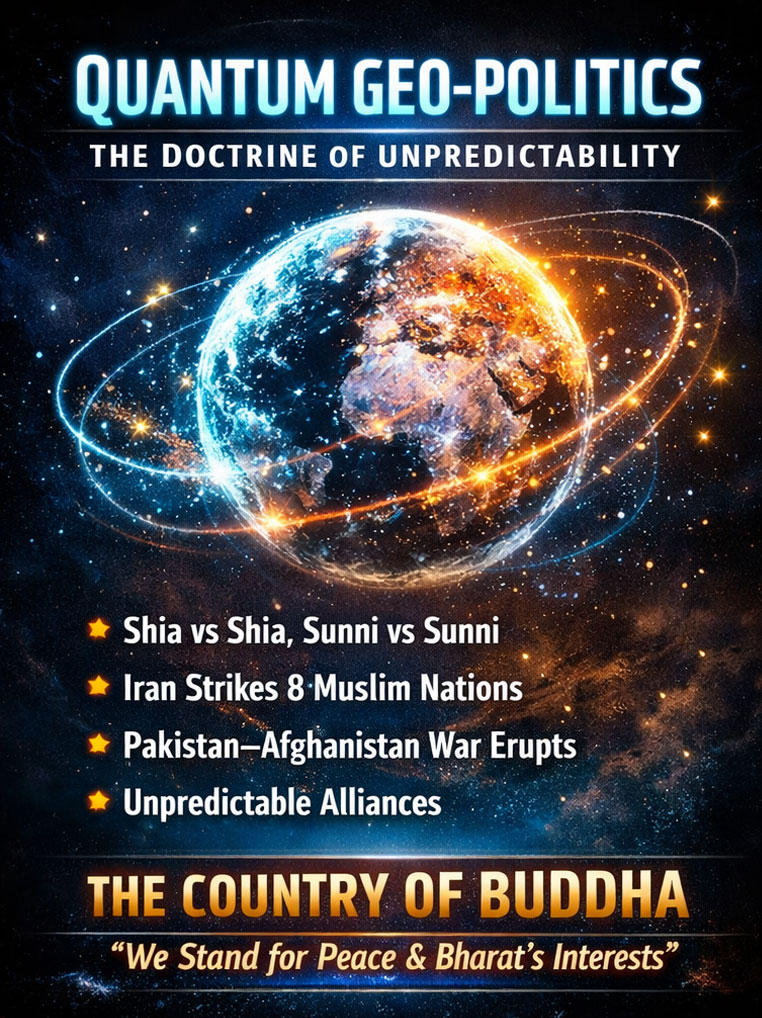
The world entered what strategists began calling Quantum Geo-Politics… a domain where positions existed in multiple states simultaneously, and alliances were probabilistic rather than permanent. A world where the core principle was unpredictability itself.
The 58 Muslim Countries in Chaos
The storm began quietly.
Within the arc stretching from North Africa to West Asia, fractures deepened. Fifty-eight Muslim-majority nations… long grouped together by religion in global imagination… revealed how artificial that unity had always been.
By late February 2026, the so‑called “58 Muslim countries” had become a living nightmare of quantum‑style conflict. Long‑standing rivalries… had turned into a web of accusations, sanctions, and missiles fired more out of political momentum than any clear strategy.
Across the Shia world, the picture was even more chaotic. Iran and its regional allies were still reeling from the fallout of the 2023–2024 missile exchanges with Israel and the Gulf. Iranian‑backed groups in Yemen, Iraq, and Syria were often at odds with each other, even as they claimed to follow the same “axis of resistance.”
A Shia group in Iraq clash with a Shia‑leaning faction in Syria; a Shia‑led government in Yemen accuse other Shia militias of sabotaging their deals. Shia and Shia were fighting each other, under the banner of being “one united front.”
Sunni fought Sunni.
Shia fought Shia.
And sometimes, everyone fought everyone.
Even long-aligned neighbors… like Pakistan and Afghanistan… both predominantly Sunni, were slamming each other in public. Pakistani leaders accused Kabul of sheltering militants; Afghan leaders accused Islamabad of meddling in Taliban politics. In actuality, both sides had shifted their stances several times within months, depending on who was in power and who was in the news. The relationship existed in a superposition of cooperation and hostility.
Recent Pakistan–Afghanistan War Escalation
The conflict exploded into open war. Pakistan launched Operation Ghazab Lil Haq (“Righteous Fury”), striking Kabul, Kandahar, Paktia, and other Afghan provinces with airstrikes on Taliban military bases, ammunition depots, and command centers. Pakistan’s defense minister declared “open war” against the Taliban, claiming 274 fighters killed and 400 wounded, while targeting 22 locations.
What began as cross-border skirmishes over militant sanctuaries and territorial claims escalated into:
- Artillery duels across border posts
- Drone strikes on suspected militant infrastructure
- Temporary closure of key trade corridors
- Mass civilian displacement from frontier provinces
Islamabad accused Kabul of harboring anti-state militants. Kabul countered that Pakistani airstrikes violated sovereignty.
The irony was unmistakable.
Afghanistan retaliated with drone strikes on Pakistani positions in Miranshah, Spinwam, and a mosque in Bannu (injuring five). Blasts rocked Kabul on March 1, with Taliban forces claiming they downed Pakistani aircraft. Pakistan hit back, destroying 73 posts and capturing 17. Casualties mounted on both sides, borders closed (like Torkham), and a Qatar‑mediated ceasefire collapsed. Pakistan accused Afghanistan of harboring TTP militants; Kabul denied it and called for talks.
In a world obsessed with Sunni–Shia narratives, two Sunni-led states were now exchanging missiles.
Religious alignment had failed to ensure political alignment.
The Islamic bloc… already fractured by Iran’s strikes across the Gulf… now showed deep geopolitical entropy.
Iran’s Strikes Across the Muslim World
Saudi Arabia, UAE, Jordan, and Bahrain… the Sunni‑leaning Gulf states… were caught in a different kind of chaos. They tried to maintain a unified front against Iran, but their alliances shifted like sand. One day, they would announce a “peace initiative” between warring factions; the next, they would quietly support a rival group. The media and public could barely keep track. The only constant was that no one could predict which side anyone would be on tomorrow.
In 2026, Iran’s frustrations boiled over into open conflict. Feeling cornered by US‑led sanctions and Israeli strikes, Iran launched a series of ballistic missile attacks across eight Muslim countries: Bahrain, Iraq, Jordan, Kuwait, Oman, Qatar, Saudi Arabia, and the United Arab Emirates. The strikes were not full‑scale war, but they were devastating enough to shake the region.
The justification: the presence of American military infrastructure across the Gulf. Iran accused the US of turning the Gulf into a “foreign base,” using its bases in Bahrain, Qatar, and the UAE to threaten Iran’s sovereignty. The US, in turn, accused Iran of destabilizing the region and threatening its allies.
The Gulf states… Saudi Arabia, UAE, Jordan, and Bahrain… retaliated with air and cyber strikes on Iranian targets. The world watched in horror as the Middle East, once again, became the center of global anxiety.
But ideology fractured under pressure. Sunni governments condemned Tehran. Shia factions disagreed among themselves. Alliances flickered like unstable particles.
The idea of a unified Muslim geopolitical front dissolved completely.
- Shia factions disagreed with Tehran’s escalation strategy.
- Sunni monarchies formed temporary tactical coalitions.
- Pakistan faced pressure from Gulf states while fighting on its western frontier.
- Afghanistan leveraged nationalist rhetoric against Islamabad.
Missiles were no longer ideological… they were transactional.
The Organization-style solidarity of decades past became ceremonial, not operational.
The crescent was no longer unified. Quantum instability spread… every country existing in a superposition of fear, pride, and ambition.
“The Country of Buddha” and India’s Quantum Role
In the middle of all this, the Prime Minister of India had repeatedly used a peculiar phrase in public:
“Only the country of Buddha will remain unshaken, because we embrace unpredictability itself.”
He had said this on four major occasions before four distinct crises:
- Before the Ukraine war escalation in 2022–2023.
- Before the Hamas–Israel war in 2023–2024.
- Before the India–Pakistan border flare‑up in 2024–2025.
- And before the Iran–Gulf missile tension in 2025–2026.
In 2026, people began to see a pattern. India, unlike most large powers, never locked itself into a single alliance box. It had moved away from the linear geopolitics prevalent before the Modi era… no fixed doctrines, no permanent camps. Instead, it dealt with each country separately, always prioritizing the interests of the people of Bharat.
The phrase was not pacifism. It was positioning.
India did not condemn uniformly.
It did not align automatically.
It did not join blocs reflexively.
Instead, it dealt with each capital separately:
- Oil from one.
- Technology from another.
- Defence partnership here.
- Humanitarian corridor there.
India’s foreign policy was no longer a straight line. It abandoned linear geopolitics… the predictable “with us or against us” doctrine… and embraced calculated unpredictability.
It was a network of shifting probabilities… a real‑world example of Quantum Geopolitics. No one could fully predict whether India would support a resolution, abstain, or quietly undermine it. That unpredictability became the country’s main strategic asset.
India’s Controlling Position in the Relationship Matrix
By 2026, India found itself in a controlling position in the global relationship matrix. It is:
A geopolitical balancing force (between US–India–Japan–Australia and Russia–China–Iran).
A major energy consumer (oil, gas, coal).
A critical tech and AI hub (software, data centers, startups).
A large defense market (buying from Russia, the US, and Europe).
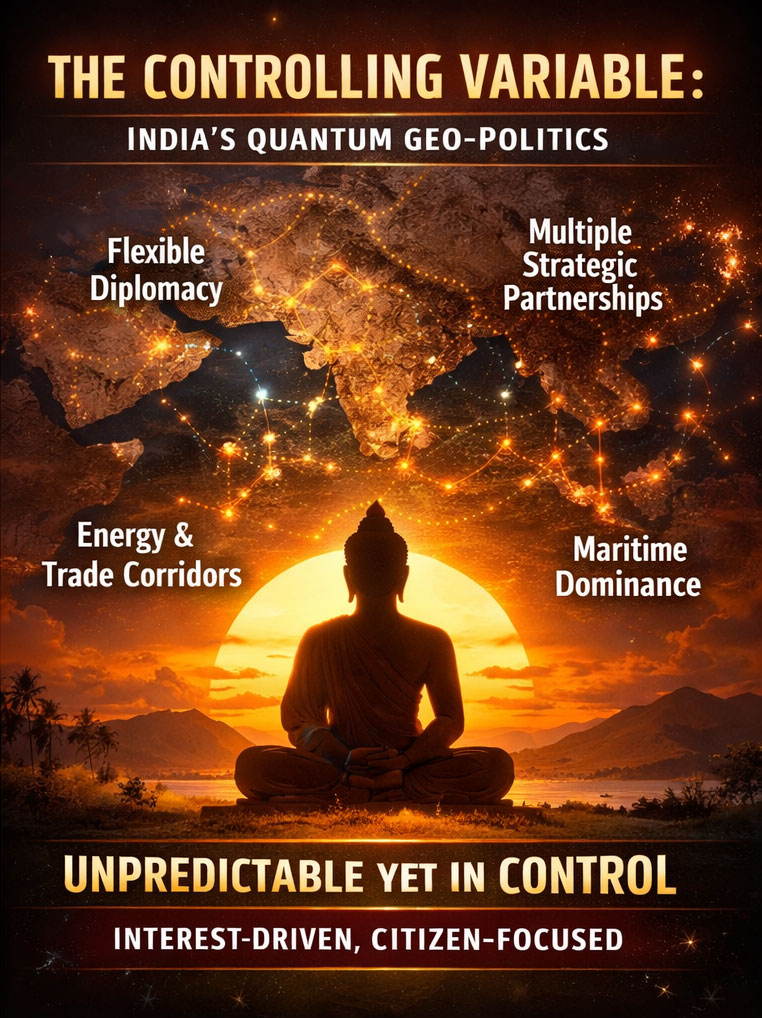
India’s leaders used unpredictability in relationships deliberately… for the benefit of its people. Indian strategists, like Rajan Solanki, described it internally as:
“Strategic Superposition.”
At any given moment:
- Bought oil from Russia, Iran, and the Gulf simultaneously.
- Sold defense gear to Ukraine and Russia sympathizers.
- Hosted talks with US, EU, and China without full commitment.
- India could conduct naval exercises with Western democracies.
- Purchase discounted energy from sanctioned states.
- Maintain diplomatic channels with rival blocs.
- Advocate peace while strengthening military deterrence.
This kept external powers off‑balance, securing cheaper energy, stable trade, and less volatility for Bharat’s citizens. Observers were confused.
Was India neutral?
Was India aligned?
Was India hedging?
The answer was: Yes. And no.
Like a quantum particle, India’s position only “collapsed” into clarity when observed at a specific negotiation table.
The Impact of the Iran–Gulf Missile War
The Iran–Gulf missile war escalated in 2026, with Iran launching attacks on the Gulf states. As Gulf states exchanged missile fire and alliances fractured, supply chains trembled. Oil markets spiked. Shipping routes became risky.
India had quietly:
- Diversified energy imports.
- Expanded strategic reserves.
- Built digital payment corridors bypassing fragile systems.
- Strengthened maritime surveillance in the Indian Ocean.
While others reacted, India anticipated.
Not loudly.
Not theatrically.
But deliberately.
Foreign diplomats visiting New Delhi found a calm, almost unsettling composure. India’s quantum approach softened the blow: diversified imports from Brazil, Venezuela, Russia, and the US; renewables; and AI efficiency. Oil prices spiked, but India suffered less than others.
One European envoy asked privately:
“Where does India stand?”
The reply from a senior advisor:
“We stand where Bharat’s interest stands… today. Tomorrow we will evaluate again.”
India’s Quantum Geopolitics had become a global model… unpredictability as power, centered on Bharat’s people.
In classical geopolitics, predictability is stability. In quantum geopolitics, unpredictability is leverage.
Because if no one can assume your response:
- They must court you.
- They must negotiate.
- They must factor you into every equation.
While fifty-eight nations argued theology and territory, India spoke economics, security, and civilizational continuity.
The “Country of Buddha” did not fire missiles.
But it controlled trade corridors.
It influenced digital platforms.
It held demographic momentum.
And in a world of collapsing alliances, that quiet power became decisive.
The 21st century no longer belonged to rigid blocs.
It belonged to adaptive states.
India did not dominate through conquest.
It dominated through ambiguity.
Not anti-West.
Not anti-East.
Not sectarian.
But interest-driven. Citizen-centric. Fluid.
The old world asked:
“Whose side are you on?”
Quantum geopolitics answered:
“It depends on the question.”
Disclaimer
Where applicable, the content is disclosed as AI-generated / synthetically generated in accordance with Indian law. All content published under the Upspoken Accord is fictional and created with the assistance of artificial intelligence (AI). The stories, characters, events, and dialogues are imaginary or inspired by events. Any resemblance to real persons, events, or entities is purely coincidental. This content is intended solely for creative and literary purposes and does not claim factual accuracy or authenticity.






Post Comment