The Caracas Gambit
The Shockwave
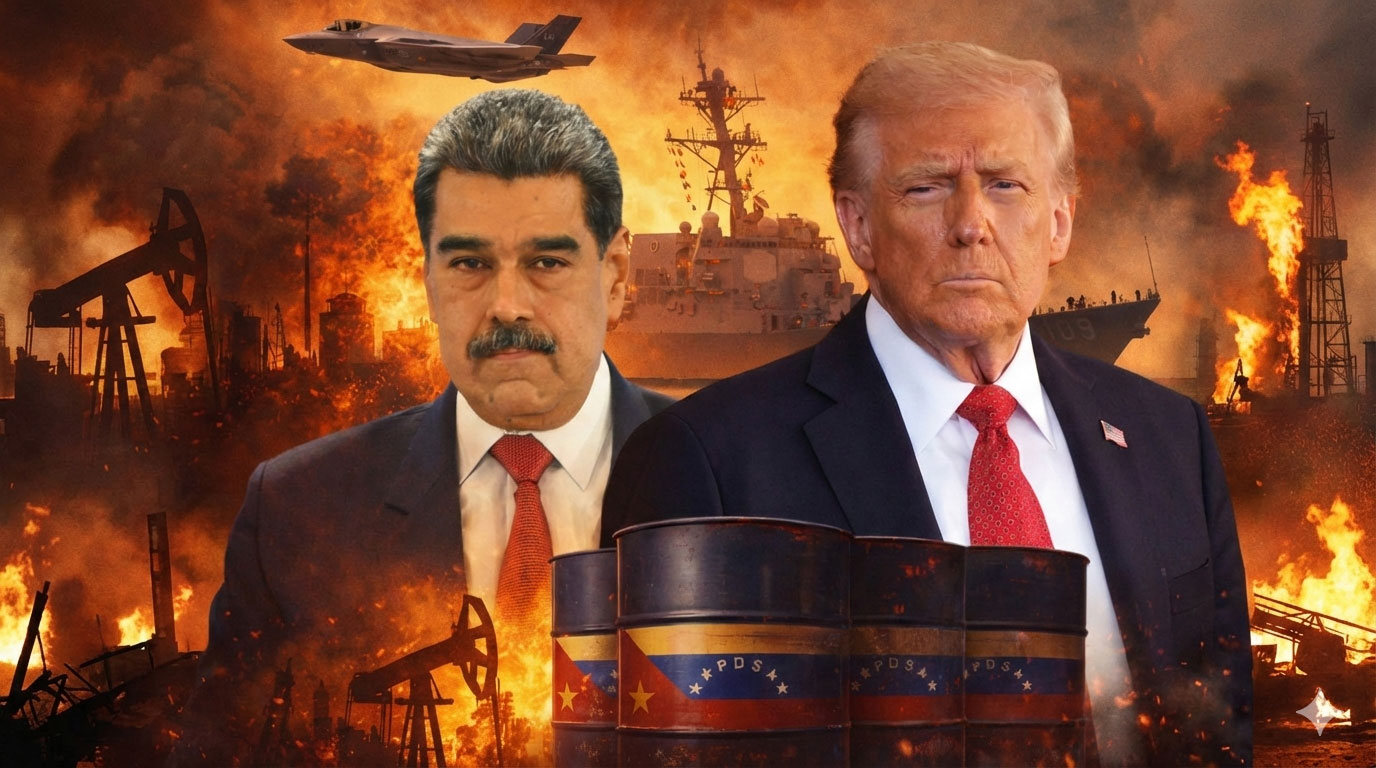
When the world first heard the news… Venezuela’s fractured leadership collapsing and a new international “stabilization coalition” stepping in… everyone assumed it was about oil, democracy, or Latin American turmoil.
But deep inside the Situation Room, and in a silent chamber inside South Block, two governments knew the truth that Venezuela was taken over to harm China more than anyone else.
Not publicly.
Not militarily.
But strategically.
Because the real battlefield wasn’t Caracas.
It was Beijing’s energy dependency.
China’s Hidden Lifeline
For years, China had quietly built a lifeline to Venezuela’s heavy crude… one of the world’s thickest, hardest-to-process oils. Chinese refineries invested billions to crack it, dilute it, and ship it across oceans.
Venezuela wasn’t just an oil supplier to China.
It was a strategic artery.
If that artery was squeezed, China’s industrial lungs would feel the pressure. Washington and New Delhi understood something Beijing didn’t expect. Only three countries on earth possessed the full capability to refine Venezuela’s toughest heavy crude:
The United States, India, and China.
Two of them suddenly aligned.
One was about to choke.
The Quiet Understanding
In 2024, long before Caracas unraveled, a quiet meeting took place in Abu Dhabi. No flags, no press, no logbook. Just analysts, energy technocrats, and a few familiar silhouettes from the US and India.
The agenda was deceptively simple. China’s power grows through oil.
China’s weakness lies in where that oil comes from.
A map was unrolled.
Red lines showed Middle Eastern routes China relied upon.
Blue lines pointed to Venezuela.
An Indian strategist said softly:
“Middle East disruptions hurt everyone.
But Venezuela… Venezuela hurts only one.”
Everyone in the room understood.
If Venezuela could be strategically reconfigured… new contracts, new refining alliances, new transport controls… then China’s heavy-oil lifeline would become a noose.
The Fall of Caracas
The collapse didn’t come through war.
It came through currency pressure, cyber strikes, defection of key military factions, and a sudden tightening of global oil credit lines.
By the time the Venezuelan president fled, the country was not invaded… it was vacuumed.
And into that vacuum stepped a “technical coalition” managed quietly by:
- American energy advisors
- Indian refinery experts
- A neutral Latin consortium
All under the banner of “rebuilding Venezuela’s energy sovereignty.”
China protested in the UN.
But the Security Council remained silent… Russia abstained, India voted neutral, US voted affirmative.
Beijing felt the floor shift.
The Refinery Trap
China had poured billions into Venezuela.
Infrastructure. Ports. Roads.
All designed to feed China’s refineries.
But suddenly the new Venezuelan authority announced: “All heavy crude exports will be renegotiated under a new stabilization framework.”
A line drafted not in Caracas…
…but in Washington and New Delhi.
China was offered only a fraction of its previous allocation… and at higher prices.
The US and India received priority access.
Not because they needed the oil immediately.
But because China needed it desperately.
China’s refineries, built specifically for Venezuela’s grade, began running below capacity.
Production lines slowed.
Shipping routes destabilized.
Internal debates erupted within Beijing’s Energy Ministry.
For the first time in decades, China felt economically exposed.
India’s Quiet Rise
The world noticed the U.S. involvement.
Few noticed India’s silent, strategic ascent.
Indian state-owned refiners gained direct access to heavy crude at prices far below global benchmarks.
A new refining corridor from Jamnagar to Visakhapatnam… long under development… suddenly became viable.
And global markets began whispering:
“India is becoming the new heavy-crude hub.”
“India is where US energy strategy leans.”
“India might replace China in Latin America.”
None of it was officially true.
All of it was strategically useful.
By 2025, India became the second-largest processor of Venezuelan heavy oil in the world… right after the US.
And China had fallen to third.
Not by accident.
But by quiet design.
Beijing’s Panic Meeting
Inside Zhongnanhai, China’s top leadership gathered around a satellite map of Latin America.
One advisor whispered the unthinkable:
“Sir… we are being pushed out of Venezuela.”
The General Secretary frowned.
“By whom?”
No one answered.
Because they all knew.
The Unseen Axis
This geopolitical era would later be analyzed endlessly.
Some experts would call it opportunism.
Others would call it energy warfare.
A few would insist it was coincidence.
But those closest to the truth would know:
Venezuela wasn’t taken for oil.
It wasn’t taken for democracy.
It wasn’t taken for regional influence.
It was taken to weaken the one nation most dependent on its heavy crude.
And in the shadows,
while China scrambled to rebuild its energy security,
two other nations quietly gained influence:
The United States and India.
A new energy axis was forming.
Not declared.
Not visible.
But unmistakable.
The Map Redrawn
By the end of 2025, the geopolitical scoreboard had shifted:
- China’s refineries slowed
- India’s refining power soared
- US regained control over Latin America’s oil corridors
- Venezuela stabilized under a “friendly” technocratic regime
- Heavy crude prices were now dictated by a US–India energy bloc
And Beijing finally understood that the battle for tomorrow wasn’t fought on borders or islands. It was fought in refineries. Venezuela was the first domino.
Not an accident.
A strategy.
A trap.
And for India, it became the quiet opportunity the world never expected.
Disclaimer
Where applicable, the content is disclosed as AI-generated / synthetically generated in accordance with Indian law. All content published under the Upspoken Accord is fictional and created with the assistance of artificial intelligence (AI). The stories, characters, events, and dialogues are imaginary. Any resemblance to real persons, events, or entities is purely coincidental. This content is intended solely for creative and literary purposes and does not claim factual accuracy or authenticity.







Post Comment