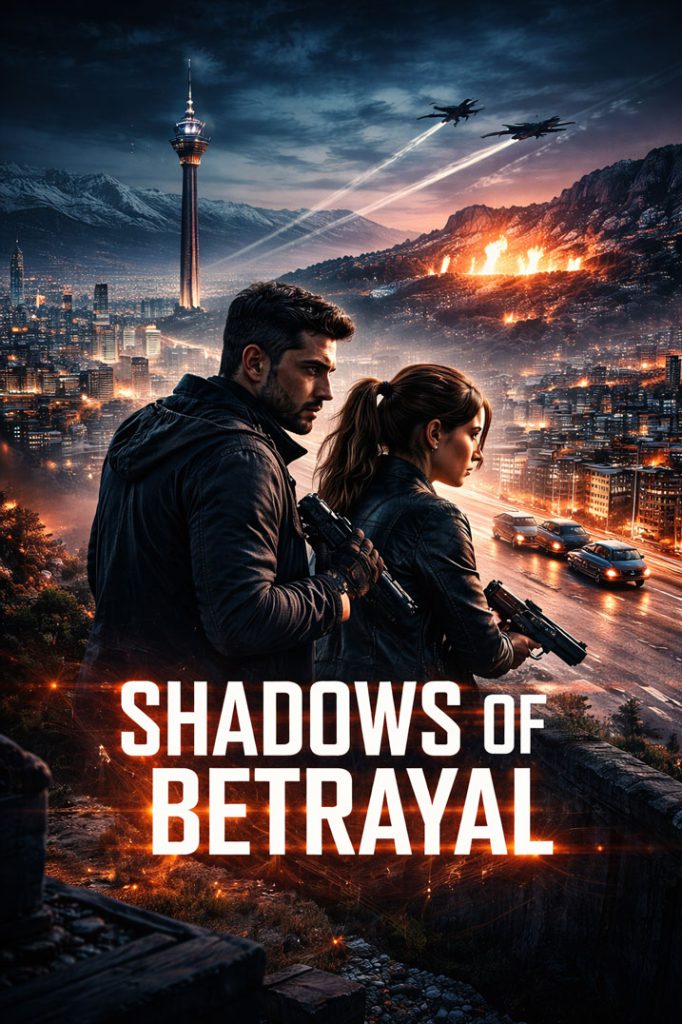
Shadows of Betrayal – Operation Iron Fury
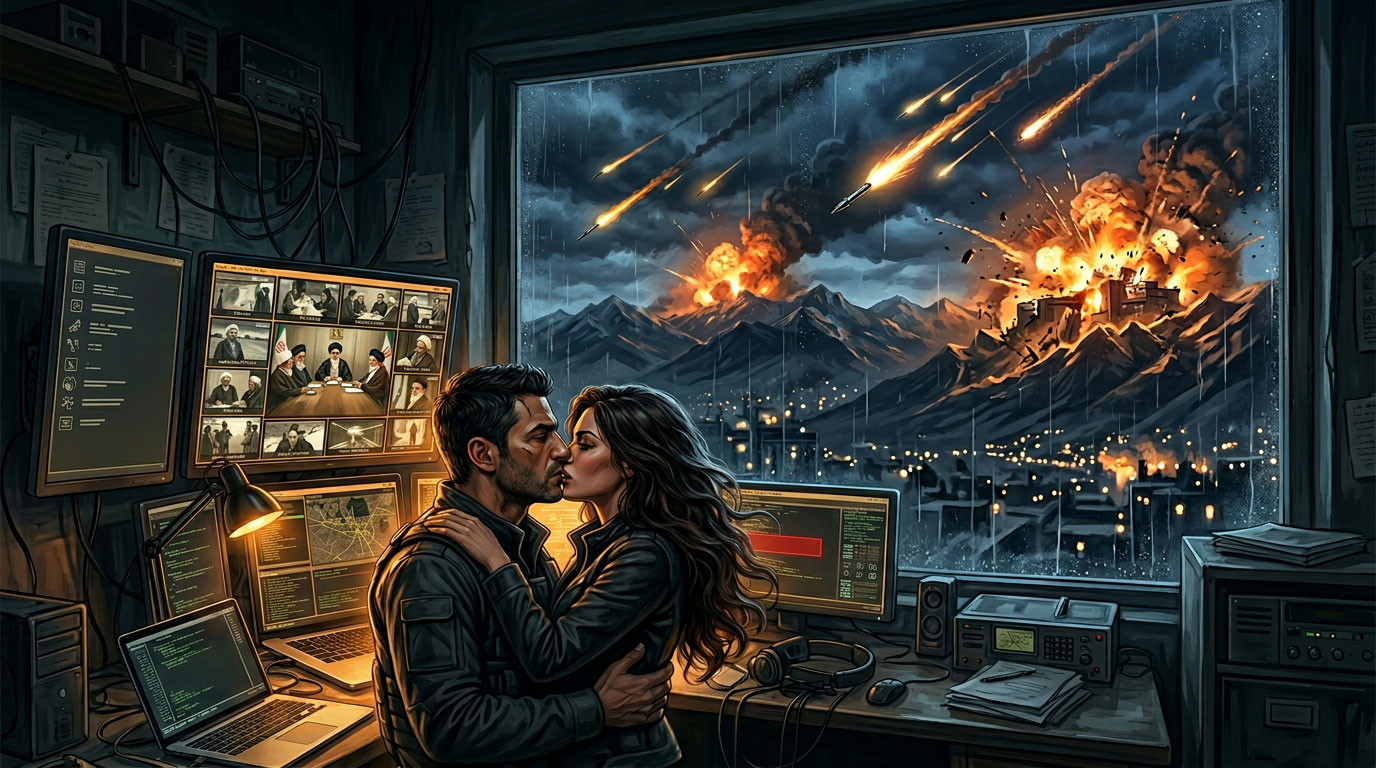
In the shadows of Tehran’s intrigue, Alireza Darvish “Arash, a conscientious objector against Iran’s regime since childhood trauma, teams with Mossad agent Catherine Sarah-Shedam in a forbidden romance-fueled espionage saga. Posing as IRGC insiders, they hack quantum-encrypted bunker cameras, spoof logistics to delay a strike amid Indian PM Modi’s visit, and lure frail Ayatollah Khamenei with his heir Supremo’s family into a fatal Natanz summit. Their live feeds guide US-Israel “Operation Iron Fury” – cyber-blinded S-400s, precision JDAMs vaporizing the leadership. Exfiltrated amid chaos, their love topples tyrants, fracturing Iran’s nuclear dreams and proxy empire in a pulse-pounding tale of betrayal, precision, and triumph.
Alireza Darvish had hated the Iranian regime since he was a boy. At 11, school drilled anti-Israel venom into him daily – chants of “Death to the Zionists” echoing in dusty classrooms. But one night shattered everything. His 17-year-old sister, defiant without her hijab, was dragged away by morality police, beaten bloody. His father bribed her freedom, but the family fled to a quiet Western haven, identities scrubbed.
At school he was taught to chant slogans:
“Death to Israel.”
“Death to America.”
But the chants felt hollow.
The regime demanded obedience. Alireza began quietly building something else – resentment.
Within a year his family left Iran for an unnamed Western country, seeking safety and anonymity. He called himself Arash now – a nod to Persia’s ancient archer-hero.
And Arash carried Iran with him.
At 30, curiosity led him to Google’s rabbit hole. He was working an ordinary job, living an ordinary life. But the past had not faded.
One evening, driven by curiosity and anger, he typed a word into Google.
Mossad.
To his surprise, the Israeli intelligence agency had a public contact page for tips. He stared at the screen for nearly ten minutes.
He wrote a short message: I want to help. I know Iran. Days later, a burner phone buzzed. “Arash,” a voice whispered in flawless Farsi, “we’ve been expecting you.”
The meeting took place in a quiet European café. The man introduced himself only as David.
He asked Arash simple questions:
- Why do you want to help?
- What do you know about Iran?
- Are you prepared to live two lives?
Arash answered calmly.
What began as curiosity quickly turned into recruitment. In 2015, Arash entered a world he had only imagined. He traveled quietly across several countries.
Training came abroad – rural safehouses in Europe, where he learned tradecraft: dead drops, ciphers, evasion, secure communications, surveillance techniques, digital intelligence gathering, psychological resilience. Eventually he was taken to Israel.
There, in a small training compound, Arash heard Hebrew spoken everywhere. Within months he could understand basic phrases. His instructors never forgot that he had grown up inside Iran’s system. For three years he built his cover – language, documents, business ties – until Tehran finally swallowed him again.”
By 2018, he was Mossad’s ghost in Tehran, feeding intel on IRGC movements, nuclear whispers, all while posing as a mid-level regime clerk.
Catherine Sarah-Shedam – Mossad’s wildcard
Catherine Sarah-Shedam entered his life two years later. She was Mossad’s wildcard – a French-Yemeni journalist with insider access, her dark eyes hiding a blade-sharp mind. Posing as a regime sympathizer, she’d infiltrated palaces, charming clerics with poetry and veiled critiques. She was unlike anyone Arash had met.
She spoke Persian like a native.
She had spent years navigating Iranian intellectual circles – quoting Persian poetry, debating clerics, with the elite gatherings. She understood the political and religious structures of Tehran.
She possessed something intelligence agencies rarely find.
Access.
And she possessed something rare in intelligence work:
Patience.
Their paths crossed at a discreet café in northern Tehran, 2024. Arash spotted her first: the subtle earpiece bulge, the too-perfect cover story. “You’re not here for the tea,” he murmured, sliding her a napkin with coordinates.
She smiled, fierce and unguarded. “Neither are you.”
Sparks flew that night over shared plates of ghormeh sabzi, trading war stories. Catherine confessed her own rage – exiled from Yemen, also a conscientious objector against tyrants. Arash opened up about his sister, the beatings that scarred deeper than skin. Their collaboration began professionally.
But espionage has a strange way of building intimacy.
When two people share secrets, trust grows quickly.
In stolen hours amid Tehran’s smog, love bloomed dangerously. They’d meet in abandoned warehouses, her fingers tracing his scars, his lips promising a future beyond shadows. “We end this together,” she’d whisper, their bodies entwined, plotting by candlelight.
Catherine’s edge was her network. Back in Tehran under journalist cover, she seduced access to the Supremo’s salon – poetic dinners where his wife, Fatima, lamented “Zionist plots.” Catherine recorded pillow talk: “The boys oversee the centrifuges; Leyla handles Hezbollah funds from the vault.” But the goldmine? Fatima’s phone sync, hacked via a USB drop at a bazaar meet. Real-time pings lit up: family rotations, bunker vents, even the Supremo’s gout meds signaling his underground hours.
Posing as an IRGC logistics officer, he’d risen via forged loyalties, now auditing Natanz’s crown jewels – and, crucially, cross-linked palace cams. Quantum-encrypted feeds from 50+ Natanz cams plus Saadabad’s elite grid beamed to Guard HQ. Mossad’s Unit 8200 ghostware payload, injected via Arash’s server farm swap, spidered outward. Disguised in firmware, it hijacked palace fiber – biometrics bypassed, AI fooled. Direct feeds flooded Tel Aviv: Khamenei hobbling war rooms, Supremo family orbiting him like moons.
Their feeds turned Iron Fury godlike. One night in February 2026, risking all, he tailed the family’s armored Mercedes to Natanz – radiation sensors beeping faintly. Planting seismic bugs on access tunnels, he synced with Catherine’s data: “Wife arrives Tuesdays; sons guard Friday prayers shift; daughter links to Quds Force Saturday.” Their shared cloud beamed it to Mossad’s war room, where IDF cyber ghosts spoofed Iranian radars. Khamenei, Supremo clan converging Friday for fatwa summit. Supremo thundered nukes; Khamenei nodded, sons armed, Fatima wired funds, daughter rallied killers.
Timing teetered on a knife-edge. Feeds showed Khamenei and clan set for Friday prayers dispersal – strike window shrinking. Then, curveball: Indian PM Modi’s official visit to Tehran, March 7-8, 2026 – diplomatic pageantry masking arms deals. US-Israel held fire; collateral risk sky-high amid motorcades. “Delay 24 hours,” Mossad ordered Arash. “Herd them to Saturday summit. No loose ends.”
Arash orchestrated from shadows, leveraging IRGC access. He spoofed logistics orders – “Supreme Leader health protocol: Natanz briefing rescheduled Saturday dawn for fatwa on Indian infidels.” Ghostware inserted memos into palace servers, cams capturing buy-in: Supremo nodding, sons rerouting convoys, Fatima canceling teas, daughter postponing Quds calls. Khamenei, gout-flared, grumbled but complied – feeds showed him dosed, prepped for bunker travel. Catherine amplified: leaked “urgent Hezbollah crisis” via Fatima’s phone, baiting full convergence.
Military operations require certainty.
One wrong detail can change everything.
But intelligence from multiple sources converged around a single conclusion. Location confirmed.
Time window identified. Risk evaluated. The operation moved forward. In the early hours before dawn, aircraft crossed the region silently. Within minutes the strike occurred.
Precise. Decisive.
The world would later debate how such accurate information had been obtained.
Saturday dawned. The entire family circle was present. Unit 8200 analysts verified the data three times.
At 03:14 AM, the order came.
“Execute.”
Stealth aircraft crossed Iranian airspace at extreme altitude. US B-2s loitered high, F-35s prepped. Cyber blinded S-400s.
Guided munitions dropped silently through the darkness. Seconds later the compound vanished in a wall of fire. Command screens in Tel Aviv went still. Primary target confirmed.
The leadership compound was destroyed.
JDAMs pierced vents – first salvo shredded Supremo mid-rant, family vaporized. Chaos erupted; Khamenei, coughing blood, fled to a sub-bunker via hidden lift – feeds tracked every lurch.
Arash and Catherine pivoted live. From Qom safehouse, they vectored a follow-up: Israeli Rampage drones, US Reaper overwatch. “Lift shaft – third level,” Catherine plotted off cams showing Khamenei’s guards piling in. Payloads funneled precise: bunker imploded, feeds cutting to static on the Leader’s final gasp. No body needed; regime confirmed “martyred.”
But then something strange appeared on the tracking feed.
A convoy signal.
Moving. Fast.
The Man Who Was Missing
Inside the operations room analysts stared at the map.
One name appeared in red. Ayatollah Reza Hosseini – A ruthless hardliner and rising power within the clerical establishment.
He had been expected inside the compound. But he wasn’t.
Catherine realized the truth first.
“He left early.”
Satellite imagery showed a helicopter lifting off minutes before the strike. The aircraft disappeared into the Alborz mountain range.
Arash and Catherine’s had bloodied the regime, but the Supremo’s son – Ayatollah Reza Hosseini, Khamenei’s ruthless heir – slipped away, regrouping with his inner circle: wife, two sons, and a daughter, all key propagandists funneling billions to proxies. From their Haifa haven, the couple itched for more.
If Hosseini survived, he could rally the Revolutionary Guard and restore command.
The entire mission would collapse.
Mossad command issued a single instruction.
“Find him within seventy-two hours.”
Arash and Catherine moved immediately.
Every intelligence channel opened.
Phone metadata.
Convoy fuel logs.
Mountain radar sweeps.
But Hosseini knew the terrain well.
He moved constantly between underground bunkers built during the Iran-Iraq War.
Time was running out. Then Catherine found something small. A financial transfer.
One of Hosseini’s sons had authorized emergency payments to a local security unit in Mazandaran Province.
Arash connected the dots. “There’s only one bunker there strong enough to hide him.”
An abandoned Cold War command facility buried inside a mountain ridge.
The crown jewel dangled: real-time location of Ayatollah Reza Hosseini, the shadowy “Supremo” – Iran’s next Supreme Leader, a hardliner plotting escalations from a fortified bunker.
Mossad needed precision for a surgical strike, no collateral. Arash’s clerk access got them schedules; Catherine’s elite circles yielded whispers. Together, they pieced it: a convoy route through the Alborz Mountains, Supremo’s helicopter shadowed by drones.
Tension peaked. Catherine, embedded as a cultural advisor, slipped Arash a micro-tracker – nao-sized, magnetic. “Plant it on the lead vehicle. I love you,” she breathed.
Using his old IRGC access credentials, he infiltrated a convoy delivering medical supplies to the bunker.
Inside the garage he spotted the armored vehicle reserved for Hosseini.
His hands were steady. He slid a micro-tracker beneath the chassis. For a moment nothing happened. Then alarms blared. Security patrols rushed into the garage. Arash ran through a service corridor, bullets tearing concrete behind him.
Outside the bunker Catherine waited in a stolen vehicle.
He jumped inside.
“Tracker active,” he gasped.
Catherine extracted him at a safehouse, pulling him into shadows. “It’s done.” But pursuit closed in – IRGC hunters, tipped by a mole. In a frantic safehouse standoff, they fought back-to-back, her silenced pistol barking, his knife flashing. A chopper exfil waited on a rooftop. As they lifted off, Tel Aviv Control crackled: “Strike authorized. Target neutralized. Clean hit.”
Iron Fury unleashed: Cyber strikes blinded defenses first – S-400s glitching to ghosts.
Precision-guided munitions fell through the night. JDAMs, guided by their bugs and pings, pierced the bunker vents with surgical accuracy.
The explosion collapsed the underground chamber.
Sensors detected no further movement. Satellite confirms: smoking crater, regime in chaos.
After days of chaos, Iran’s remaining leadership structure was gone.
Exfil was poetry. A Mossad sub off Bandar Abbas scooped them from a beach rendezvous, Catherine patching Arash’s shrapnel graze. Back in Haifa, medals pinned in secret, they toasted: “We finished the nest.” Iran fractured – proxies starved, nukes stalled. Their love, forged in fire, etched history.
After the operation, Arash sat alone in a safe apartment overlooking a foreign city.
Catherine joined him on the balcony. Neither spoke for several minutes. Espionage victories rarely feel like celebrations. They feel like endings.
“Do you regret it?” she asked.
Arash thought about Tehran.
About his sister. About the night that changed everything.
“No,” he said quietly. “But I wish things had been different.”
Catherine nodded.
Years later, in a Haifa villa, Arash and Catherine watched sunsets, scars faded but fire eternal. “We burned their throne,” he said, her hand in his. Iran reeled, Mossad’s legend grew. Love had armed the arrow.
In intelligence work, history is shaped not only by governments and armies.
Sometimes it is shaped by one message sent from a laptop… by someone who refused to forget.
Disclaimer
Where applicable, the content is disclosed as AI-generated / synthetically generated in accordance with Indian law. All content published under the Upspoken Accord is fictional and created with the assistance of artificial intelligence (AI). The stories, characters, events, and dialogues are imaginary or inspired by events. Any resemblance to real persons, events, or entities is purely coincidental. This content is intended solely for creative and literary purposes and does not claim factual accuracy or authenticity.








Post Comment