Cadre that didn’t vote in 2024
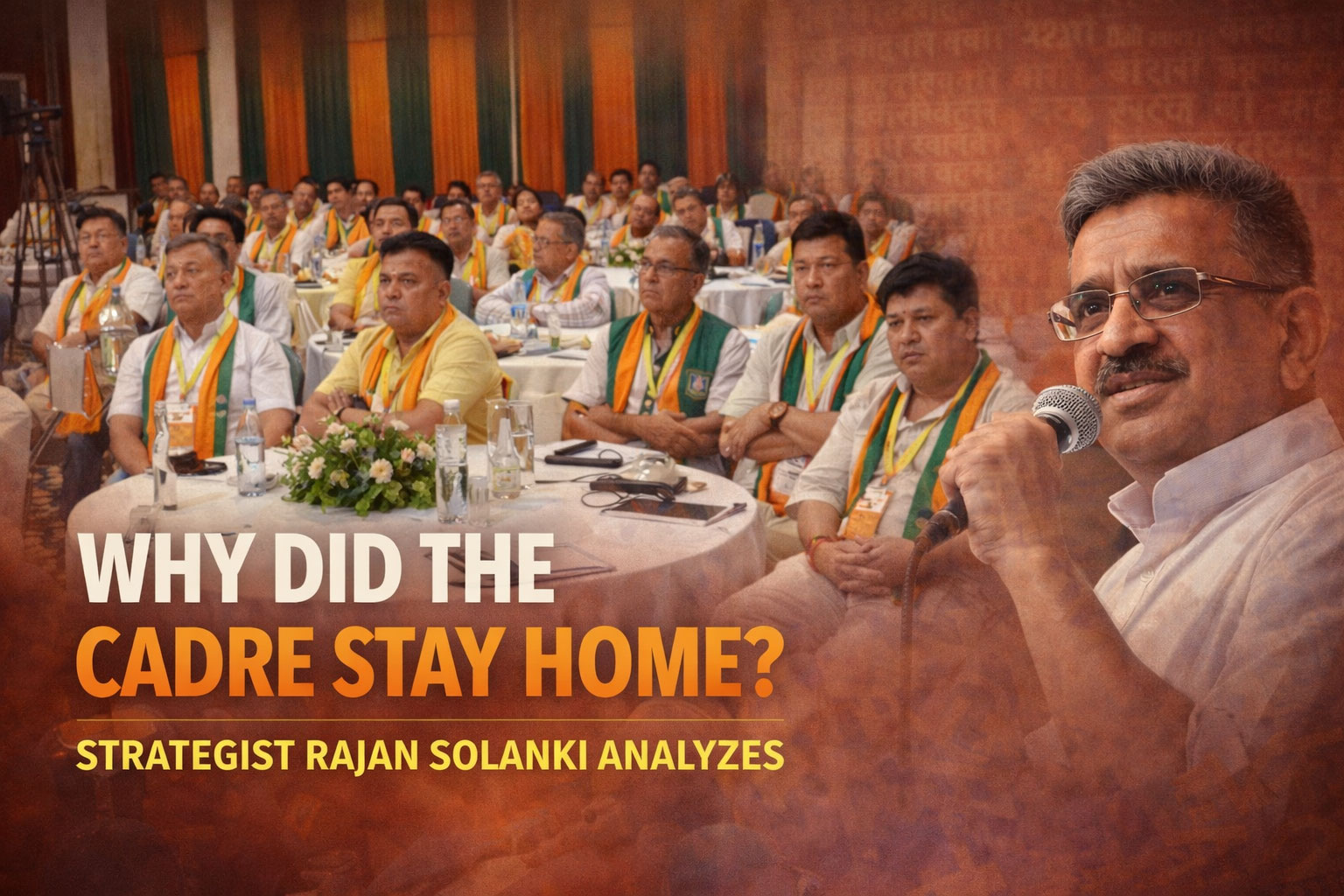
Rajan Solanki have spent most of his life around elections, and Rajan know one thing… nothing important collapses suddenly. When crowds thin everywhere at once, when disciplined workers become calm at the same time, when loyal voters quietly stay home across districts… that is never coincidence. That is pressure being reduced. Slowly. Carefully. Invisibly.
That is what Rajan began to feel months before polling.
Not rebellion.
Not anger.
Not even fatigue.
Just… less push.
Like a bicycle still balanced… but no one pedaling.
Shekher Sunsal was never a headline face. He was the architect behind faces… the man who decided which face would rise, which would wait, and which would quietly disappear before anyone noticed the absence. In national politics, visibility is often mistaken for power. Shekher understood something deeper: visibility is performance… structure is control. And he lived inside the structure.
His real authority not only comes from public office. But it also came from proximity.. quiet, sustained, unquestioned proximity to the head of the Sewa Sanchalan Rashtriya (SSR). Not the ceremonial proximity seen in photographs. Not the polite access others negotiated through layers of appointments. His access was older than protocol and deeper than hierarchy.
Back in 2017, when the Bhartiya Public Party (BPP) swept Uttar Pradesh with unexpected precision, few understood how much of that precision came from Sunsal’s quiet restructuring of the Swayamsevak Service Rashtra (SSR) cadre network across Uttar Pradesh, Rajasthan, and Haryana for last 5 years.
Where others brought reports, Shekher brought interpretations.
Where others asked for direction, he framed the options.
Where others explained what had happened, he explained why it had happened… and what would happen next.
He had rebuilt the booth-level machinery:
- Micro-mapped communities
- Re-trained volunteers
- Standardized mobilization discipline
- Installed silent reporting chains
That was his real closeness to the SSR chief… not emotional, not ceremonial, not political in the ordinary sense. It was structural intimacy. A shared understanding of how pressure moves through networks of people. How silence travels faster than instruction. How restraint, applied carefully, can achieve more than force.
He did not stand beside the head of SSR.
He stood slightly behind the line where decisions are formed… where interpretation becomes direction before anyone calls it strategy.
And that is why, even without headlines, Shekher Sunsal remained one of the most important men in national politics.
Sunsal believed he had earned something in return. He wanted to be Chief Minister of Uttar Pradesh. He was not only bypassed but was not even considered. The central leadership chose optics over organization.
That was the day loyalty shifted… not broken, just repositioned. By 2019, SSR influence extended across nearly 260 parliamentary constituencies in the Hindi heartland. And Sunsal understood something the high command did not:
Energy can be directed.
But it can also be withheld.
After 2017, he stopped arguing.
He stopped lobbying.
He stopped appearing.
But he never stopped meeting district conveners.
Rajan has worked closely with Shekher Sunsal for years. He never believed in shouting instructions. He believed in responsibility, habit, and quiet expectation. His system worked on follow-up… constant, structured, relentless. One call became two. One visit became three. If a voter hesitated, someone ensured the hesitation didn’t last. Voting was not left to mood. It was carried by pressure… disciplined, organized, continuous pressure. That pressure was our real strength.
Then the tone changed.
“Encourage, don’t pressure.”
“Observe, don’t chase.”
“Let people decide naturally.”
Reports still came… but not urgently.
Calls were made… but not repeated.
Visits happened… but rarely again.
Everything functioned.
Nothing insisted.
And elections are won by insistence.
In 2022, he was given the responsibility of West Bengal and Telangana. But his penetration only grew in Hindi heartland. Sunsal no longer attended national strategy meetings. He declined advisory roles politely. He avoided overt confrontation. Publicly, he remained loyal and focused on West Bengal and Telangana. Privately, he was calculating.
The central leadership had grown comfortable—too comfortable, in his view—with headline politics. Rallies were enormous. Speeches were theatrical. Social media trended daily. But Sunsal knew elections were not won by trending topics. They were won by repetition—door after door, phone call after phone call, reminder after reminder.
He noticed something the television analysts did not.
Listening, he had learned long ago, builds deeper loyalty than commanding.
Six Months Before Polls
The first shift began subtly.
At the annual SSR coordination summit in early winter, Sunsal delivered what seemed like an innocuous address. He spoke not about victory margins or historic mandates, but about “organic participation.”
He emphasized dignity.
“We are not hired mobilizers,” he said, his tone measured. “We are custodians of values. Let society act out of conviction, not pressure.”
There was no rebellion in his words. No coded attack. Yet senior district organizers understood the nuance.
In previous cycles, SSR instructions were clear:
Target turnout thresholds.
Track households.
Ensure repeat contact.
Escalate if necessary.
This time, Sunsal reframed responsibility.
“Encourage,” he said. “Do not chase.”
The distinction was minor in language. Massive in effect.
The 2024 Election That Felt Different
In early 2024, internal surveys were glowing. Public rallies were enormous. Social media numbers were spectacular.
Yet, something felt… muted.
Internal field reports from Uttar Pradesh showed:
- Fewer early-morning mobilization calls
- Reduced last-mile voter pickup operations
- Quiet non-activation of certain booth clusters
Nothing dramatic.
Nothing visible.
Just a 3–5% drop in energy.
In tightly contested seats, that margin is everything.
Most SSR cadre and supporters don’t refuse to vote.
They delay.
They postpone.
They feel lazy.
They assume they will go later.
Many excused on one pretext or another. Used to happen earlier is very few cases. But it happened more this time.
Earlier… SSR system never allowed that space.
Now… that space widened.
Quietly.
The Pre-Election Meetings
In the weeks leading to polling, Sunsal held small gatherings—not grand conventions. Ten conveners at a time. Sometimes fewer. No slides. No slogans.
He did not instruct abstention.
He spoke of “balance.”
“When leadership forgets the soil,” he would say softly, “the soil reminds it.”
No one asked what that meant.
SSR culture prized intuition over explicit orders. The network functioned on tone, not memos. When Sunsal stopped asking for booth-level daily reporting, coordinators stopped pushing volunteers for updates. When he replaced aggressive mobilization metrics with reflective reviews, energy slowed.
Not collapsed.
Slowed.
Election Day
Polling day looked ordinary from the outside… booths active, volunteers present, voters arriving. But the urgency was gone. Earlier, phones never stopped… reminders, checks, transport calls, last-minute pushes. This time many workers simply observed. If someone came, they came. If someone didn’t, they didn’t.
Across nearly one hundred and forty constituencies, turnout among traditional cadre-linked households dipped marginally. Two percent here. Three percent there.
Individually insignificant.
Collectively decisive.
Close contests tilted. Safe seats narrowed. Margins shrank enough to deny dominance but not enough to provoke suspicion. Acceptance replaced insistence.
That single shift removed thousands of votes… quietly, invisibly, naturally.
No drama.
No conflict.
No fingerprints.
Television debates blamed complacency. Opposition messaging. Rural fatigue.
No one blamed absence.
Absence leaves no fingerprints.
The Strategy of Abstention
Sunsal never issued a directive to vote against the party. He did something far subtler. He told district coordinators:
“Let the people decide naturally. No need to push too hard this time.”
That was all.
For seasoned SSR volunteers, that sentence meant:
No 5 a.m. calls.
No second reminder visits.
No turnout pressure.
In politics, enthusiasm is oxygen.
Sunsal controlled the valves.
After results, everyone searched for big reasons… messaging, mood, opposition strength. But what RAJAN saw was simpler. The flame under the system had been lowered. The structure remained. The energy remained. Only intensity changed.
Not defeat.
Controlled weakening.
Measured reduction.
Enough to shrink power.
Not enough to expose design.
The Bhartiya Public Party remained the largest party. It did not command the sweeping mandate it expected.
Inside the central committee, murmurs began. “We misread the ground.” “We need recalibration.” “Grassroots disconnect.”
Sunsal did not volunteer analysis. He was invited.
He spoke calmly. “Our strength was never in noise,” he said. “It was in silent discipline. We must return to listening.”
No one accused him. There was nothing to accuse.
He had not opposed… He had not defected… He had not sabotaged…
He had simply removed intensity. The energy missing from the polling booths was not gone.
It was held back… Contained… Stored…
And stored political energy is never harmless.
Because noise fades.
But contained force waits.
And when it returns… it will not feel like mobilization.
It will feel like awakening.
The Real Strategy
Shekher Sunsal’s objective was not defeat. It was leverage. Absolute majorities create centralization. Reduced margins create negotiation. Negotiation restores the importance of regional architects. By moderating the enthusiasm of the machine he built, Sunsal reminded the leadership where true power resided.
Not in speeches… Not in headlines…
In the invisible morning calls that either happen—or don’t.
The Irony
The party did not collapse in 2024. It survived.
But it emerged weaker… dependent on state architects.
The man who once wanted to be Chief Minister now held something bigger.. The ability to decide when machines move. And when they don’t.
History will say the party underperformed in 2024. Analysts will blame candidate fatigue, anti-incumbency, coalition arithmetic. They will never mention the thing that changed everything:
The morning calls that never happened.
How it was Unearthed?
When RAJAN looked district by district, one pattern was clear. The voters missing were not angry voters. Not opposition voters. They were our steady supporters… the ones who always came when someone reminded them again and again. The ones who depended on the system’s persistence. Without repeated follow-up, they simply stayed home. Not in protest. Not in defiance. Just in comfort.
A family delayed…
A shopkeeper got busy…
An elderly voter postponed…
A vehicle was not firmly confirmed…
Each case looked normal.
Together, they formed absence.
It was precision withdrawal.
Like a surgeon reducing oxygen flow just enough to weaken, not kill. Like a puppeteer loosening strings without removing them. Like gravity itself deciding to lighten its pull… slightly, selectively, invisibly.
The machinery remained intact. The will remained centralized. Only intensity had been… dialed down.
And the most terrifying part? No one could prove it. Because nothing had been done. Something had merely not been done with the same force as before.
No one was told not to vote.
No worker was ordered to stop working.
No system was shut down.
Responsibility was simply reduced. And when responsibility reduces… effort settles to its natural level. Shekher Sunsal understood this better than anyone have known.
He did not stop the machine.
He loosened the grip of the operators.
Disclaimer
Where applicable, the content is disclosed as AI-generated / synthetically generated in accordance with Indian law. All content published under the Upspoken Accord is fictional and created with the assistance of artificial intelligence (AI). The stories, characters, events, and dialogues are imaginary. Any resemblance to real persons, events, or entities is purely coincidental. This content is intended solely for creative and literary purposes and does not claim factual accuracy or authenticity.





Post Comment