The double game : Punjab Politics
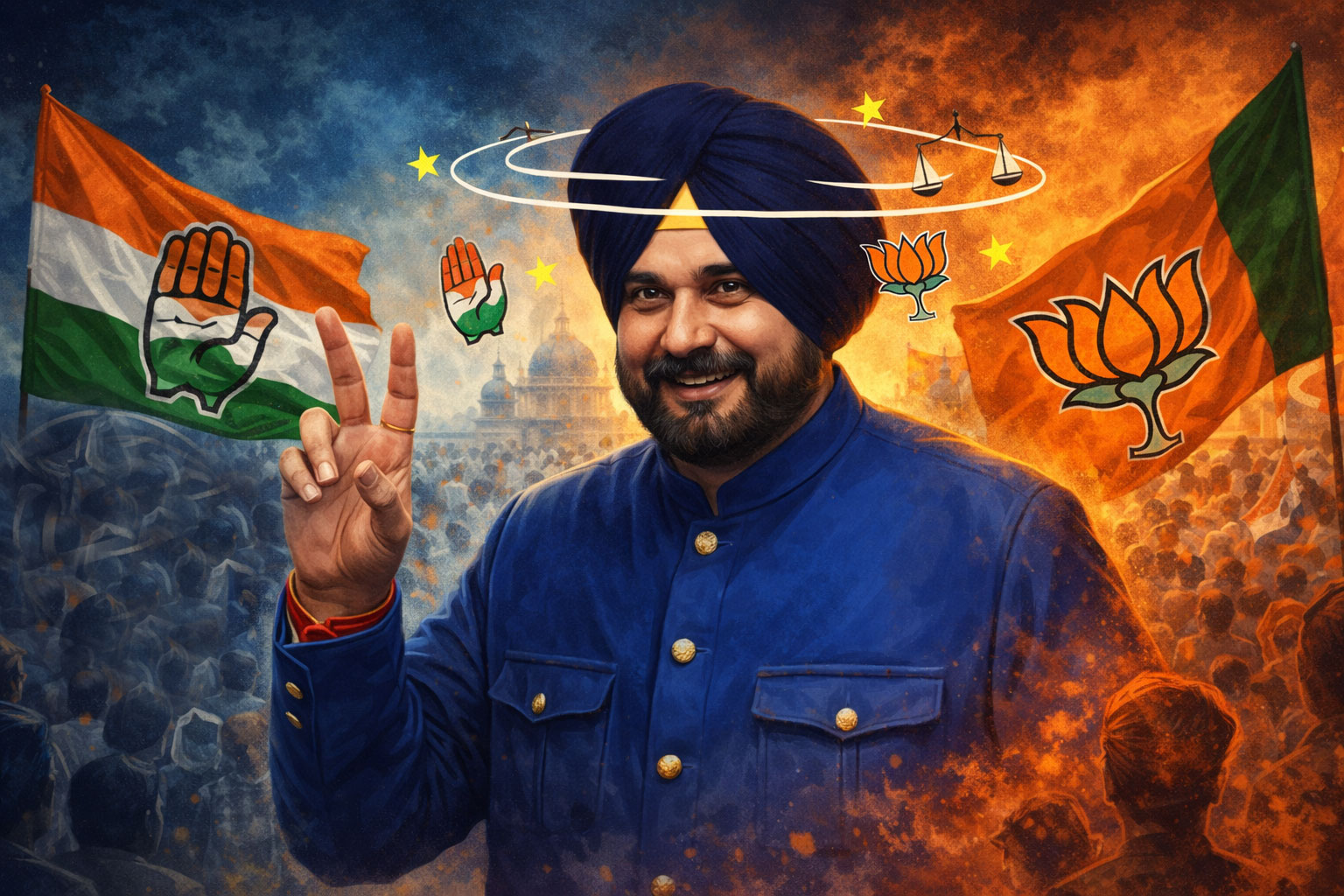
NS Sadhu had always been many things… cricketer, entertainer, orator, rebel. But, he was something far more dangerous..
A man playing two sides of the political chessboard at once…
Crowds didn’t come to hear policy. They came to hear laughter, metaphors, thunderous lines delivered with the confidence of a man who had already conquered one world and was curious about the next. His fame preceded him into every hall… cricketing triumphs, television applause, and a voice that could turn even a dull evening into performance.
Politics, at first, was an extension of that stage.
He joined the National Bloc when it still believed charisma could win constituencies by itself. It worked. Sadhu became a multiple-term parliamentarian, a familiar face in Delhi, a reliable crowd-puller. His wife, Navya, entered politics too… sharp, articulate, unafraid. Together they formed a power couple, their ascent coinciding with coalition governments where access mattered as much as ideology.
Navya’s elevation to a junior parliamentary role felt natural then… another step in a shared climb. When courts later struck that arrangement down, it barely dented their momentum. In Punjab, optics mattered more than footnotes.
The story begins in 2017, long before Punjab sensed any political hurricane. At a secluded farmhouse near Zirakpur, a black SUV stopped at midnight. Two men waited inside… both seasoned strategists of the ruling party at the Centre. They weren’t there for negotiations.
They were there to make an offer.
Sadhu walked in wearing his trademark grin. “Tu si kehna ki karna hai?”
(You tell me what needs to be done?)
The taller strategist spoke softly, “Punjab is slipping. We need a man inside the Congress. Someone with charisma… someone unpredictable… someone who can shake the ground.”
“And what do I get?” Sadhu asked…
“Freedom. Spotlight. And when the time comes… support.”
Sadhu leaned back, considering the impossible…
That night changed the course of Punjab politics…
A sitting Rajya Sabha Member, nurtured and elevated by a central political party, he chose to walk away from institutional certainty in 2017. The decision stunned corridors of power. It was not driven by electoral arithmetic alone, but by an accumulating sense of ideological suffocation and personal dissonance…
When Sadhu dramatically joined Congress in 2017, the public saw it as rebellion against the BJP. But in this story, only three people knew the truth… Sadhu was going inward, not away. His mission… was simple… Gain trust… Rise fast… Divide quietly… Weaken the party from within… Leave Congress fractured enough to lose its grip…
A political sleeper agent… Punjab politics had never seen such a character…
The move was framed as ideological awakening, but insiders understood it as timing… It was neither.. The party needed a face that could disrupt… Sadhu pretended he needed a platform that promised prominence…
The gamble paid off…
Contesting from Purab Amritsar, Sadhu won by a landslide that silenced skeptics and emboldened supporters. The margin was not merely electoral; it was psychological.
The party won… Sadhu became a minister under a veteran chief minister whose strength was stability… everything Sadhu was not planning to be… He was sworn into the state cabinet almost immediately, handed portfolios that touched both heritage and urban governance… areas where symbolism mattered as much as policy.
For a brief period, Sadhu thrived.
As Minister for Culture and Civic Affairs, he championed Project Virasat, a revival initiative aimed at preserving an ancient brass-craft practiced by a small artisan community near his former parliamentary stronghold. The craft had international recognition, but local neglect. Sadhu’s involvement brought attention, funding, and cameras. For once, the applause felt earned.
In 2018, Sadhu accepted an invitation across the border to attend the oath-taking of a newly elected prime minister of a neighboring country. The event was meant to signal goodwill.
Instead, one gesture… an overly warm public embrace with the neighboring army chief… dominated headlines back home.
The Chief Minister, Captain Amar Nath, reacted sharply. For him, symbolism without sensitivity was recklessness. For Sadhu, it was miscalculation born of instinct.
The rift widened.
By mid-2019, Sadhu was stripped of both his portfolios. Officially, it was a cabinet reshuffle.
Unofficially, it was punishment. Around the same time, the Election Commission barred him briefly from campaigning after a speech was deemed to have crossed ethical lines. The pattern was becoming familiar: Sadhu’s words moved faster than his caution.
Sadhu ‘stalent was not in strategy… it was in emotion.
He could electrify a room with a sentence and scorch a leader with a single line.
Within months, small cracks appeared inside Punjab Congress:
• Ministers whispered against each other
• MLAs split into camps
• Leadership disputes deepened
• Every decision became a drama
And at the center of the storm… was Sidhu, smiling innocently, “Main tan sirf sach bol reha si.”
(I was only speaking the truth.)
But truth, in politics, is a weapon sharper than any blade…
Sadhu’s dissatisfaction was not ideological.. it was positional… He believed his mandate extended beyond a cabinet berth… The party’s old guard, in his view, had overstayed its welcome… Punjab needed energy, noise, disruption… and he could provide all three…
Sadhu was not alone… Others chafed under the chief minister’s cautious leadership… Together, they began a slow, careful revolt… media appearances calibrated, statements sharpened, loyalty questioned without being broken outright…
For a brief moment, Sadhu looked like the inevitable successor…
But the party rewards loyalty and slavery to The Family… They could sense slavery will be missing with Sadhu…
By the time Captain Harvinder Singh stepped down, the party’s unity was gone.
Sadhu had become the vortex around which everything spun… and shattered…
He played the role so perfectly that even those closest to him didn’t suspect anything.
The high command chose compromise over charisma, elevating a consensus face instead…
Sadhu was sidelined with ceremony, not confrontation. The decision hurt more than an outright rejection would have…
Inside the party, leadership changed. Rajender Shanii, younger, sharper, firmly aligned with the
The Family command, took charge. Sadhu’s era seemed definitively over…
In a move that surprised many, the party elevated Sadhu as state president, replacing a quieter, more methodical leader. It was a calculated risk… bringing volatility back into the center in the hope that energy could compensate for friction.
It didn’t last.
Within months, Sadhu resigned from the post, citing conscience and conflict. The central leadership refused to accept it, exposing the paradox of his career: indispensable, yet uncontrollable.
When elections came again in 2022, Sadhu returned to the same constituency that had once crowned him. This time, the verdict was unforgiving. A candidate from a new political force defeated him decisively.
The crowd that once roared had moved on….
Sadhu remained, technically, within the party. No expulsion. No reconciliation. Just a prolonged pause…
What followed was collapse.
He had moments of impact.
He had flashes of governance.
He had the numbers once….
The election that came next was brutal. The party lost power. Sadhu lost his seat. Punjab chose a different narrative altogether… one that promised simplicity over spectacle.
As political defeat settled in, the past arrived uninvited.
An old legal case from Sadhu’s youth… long dormant, legally complex… suddenly reached conclusion. The sentence was short but symbolic. Prison doors closed. The applause stopped.
At the same time, life intruded in harsher ways. Navya faced a serious illness, shifting priorities overnight. Politics receded. Survival took precedence.
When Sadhu emerged, it was not onto a rally stage but onto a television set… returning to his role as the genial oracle, dispensing laughter instead of manifestos. The audience welcomed him back. Politics did not.
But revolts leave residue.
Navya refused quiet exit. Her public letters scorched bridges… accusations of corruption, incompetence, betrayal. The response was immediate and unforgiving: suspension, counter-statements, and a public assertion that the break had already happened. A remark about money and power… careless or calculated… became the final rupture.
Sadhu watched from the sidelines, silent, technically still a party member, politically homeless.
Sadhu did not announce his withdrawal from politics. He simply stopped knocking on doors that no longer opened. Attempts to reconnect with the leadership… through intermediaries, through old allies… yielded politeness but no appointments.
The party had moved on.
Rajan Waring represented a different generation, a different loyalty structure. Sadhu’s unpredictability, once an asset, was now a liability. His wife’s public war had closed whatever space remained.
And so Sadhu settled into ambiguity.
He attended no rallies. Issued no manifestos. He remained, on paper, a party man… his name still listed, his membership intact. In practice, he belonged nowhere.
The television studio became his refuge. There, he was still revered. Still applauded. Still addressed as “guru.” Laughter filled the silence politics had left behind.
Occasionally, reporters asked about his future. He smiled. Deflected. Spoke of destiny, timing, faith.
Punjab politics continued without him.
Younger leaders filled the vacuum. New conflicts replaced old ones. Sadhu’s name surfaced mostly in retrospectives… what could have been, what almost was.
Navya remained combative, her words sharper now that nothing was left to lose. The party responded with indifference, the most effective rebuttal of all.
One winter evening in 2025, Sadhu received a single-line encrypted message on an old phone he never carried in public:
“Storm complete. Return whenever ready.”
He laughed softly….
Punjab was now a battleground with no clear captain and congress left standing.
Exactly as designed…
Years later a retired bureaucrat writing his memoir stumbled upon hints.. meeting logs, secret transfers, unusual calls made from ministerial offices at odd hours…
Everything pointed to one astonishing pattern: Sadhu ‘smoves inside Congress aligned perfectly with the strategy of the party ruling at the Centre…
If it were ever proven, it would be the greatest political double-game in India’s recent history.
But like all great conspiracies, the truth stayed hidden behind layers of deniability…
A man who had fractured a party from within…
while pretending to be its brightest star.
Punjab remembers him not for the matches he played, but the one game he mastered… the game of silent betrayal…
Disclaimer
Where applicable, the content is disclosed as AI-generated / synthetically generated in accordance with Indian law. All content published under the Upspoken Accord is fictional and created with the assistance of artificial intelligence (AI). The stories, characters, events, and dialogues are imaginary. Any resemblance to real persons, events, or entities is purely coincidental. This content is intended solely for creative and literary purposes and does not claim factual accuracy or authenticity.






Post Comment